
- Home
- About Us
- TSPT Academy
- Online Courses
-
Resources
- Newsletter
- Business Minded Sports Physio Podcast
- Day in the Life of a Sports PT
- Residency Corner
-
Special Tests
>
-
Cervical Spine
>
- Alar Ligament Test
- Bakody's Sign
- Cervical Distraction Test
- Cervical Rotation Lateral Flexion Test
- Craniocervical Flexion Test (CCFT)
- Deep Neck Flexor Endurance Test
- Posterior-Anterior Segmental Mobility
- Segmental Mobility
- Sharp-Purser Test
- Spurling's Maneuver
- Transverse Ligament Test
- ULNT - Median
- ULNT - Radial
- ULNT - Ulnar
- Vertebral Artery Test
- Thoracic Spine >
-
Lumbar Spine/Sacroiliac Joint
>
- Active Sit-Up Test
- Alternate Gillet Test
- Crossed Straight Leg Raise Test
- Extensor Endurance Test
- FABER Test
- Fortin's Sign
- Gaenslen Test
- Gillet Test
- Gower's Sign
- Lumbar Quadrant Test
- POSH Test
- Posteroanterior Mobility
- Prone Knee Bend Test
- Prone Instability Test
- Resisted Abduction Test
- Sacral Clearing Test
- Seated Forward Flexion Test
- SIJ Compression/Distraction Test
- Slump Test
- Sphinx Test
- Spine Rotators & Multifidus Test
- Squish Test
- Standing Forward Flexion Test
- Straight Leg Raise Test
- Supine to Long Sit Test
-
Shoulder
>
- Active Compression Test
- Anterior Apprehension
- Biceps Load Test II
- Drop Arm Sign
- External Rotation Lag Sign
- Hawkins-Kennedy Impingement Sign
- Horizontal Adduction Test
- Internal Rotation Lag Sign
- Jobe Test
- Ludington's Test
- Neer Test
- Painful Arc Sign
- Pronated Load Test
- Resisted Supination External Rotation Test
- Speed's Test
- Posterior Apprehension
- Sulcus Sign
- Thoracic Outlet Tests >
- Yergason's Test
- Elbow >
- Wrist/Hand >
- Hip >
- Knee >
- Foot/Ankle >
-
Cervical Spine
>
- I want Financial Freedom
- I want Professional Growth
- I want Clinical Mastery
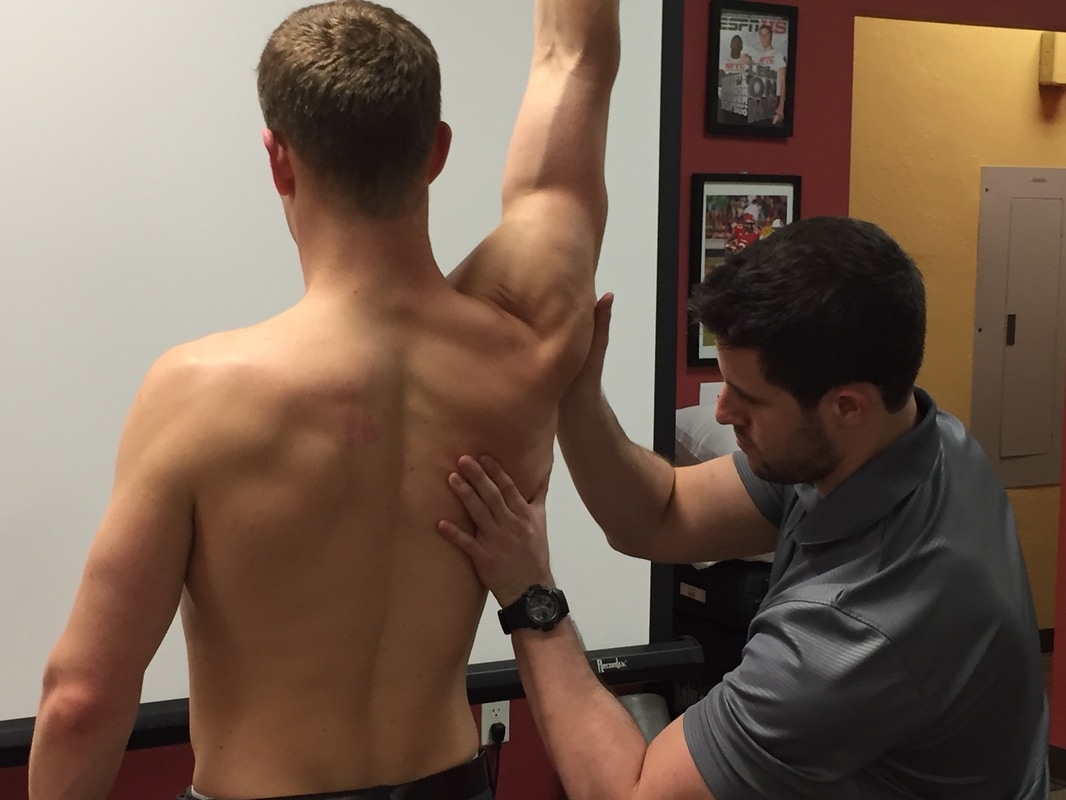

Active Compression Test
Purpose of Test: To test for the presence of a labral tear or acromioclavicular lesion.
Test Position: Sitting or standing
Performing the Test: The patient is instructed to place the shoulder into 90 degrees of flexion and 10 degrees of adduction. Next, the arm is actively internally rotated so the thumb is pointing downward. The instructor then applies a inferior directed force (into shoulder extension), first with the thumb pointing down and a second time with the thumb pointing up.
The test is considered positive for an acromioclavicular lesion if the patient has localized pain in the AC joint with the thumb pointing down & a decrease in pain with the thumb pointing up (supinates the forearm).
The test is considered positive for a labral tear if the patient reports a painful clicking in the joint with the thumb pointed down, which is reduced or eliminated when the patient resists the inferior force with his thumb up (supinates the forearm).
Diagnostic Accuracy:
Acriomioclavicular Lesions: Sensitivity: .41-1; Specificity: .95-.97; +LR: 8.2-33.3; -LR: 0-.62
Labral Tear Sensitivity: .63-1.0; Specificity: .73-.98; +LR: 2.3- 50; -LR: 0-.51 (Taken from Flynn).
Importance of Test: Both acromioclavicular joint separations and labral tears are common shoulder injuries. There are different degrees of an AC joint separation and different types of labral tears, so a careful clinical examination is crucial. Understanding the severity of each injury is an important component to your evaluation as it will affect the patient’s prognosis. When reviewing the anatomy, it is clear why the position of the thumb will alter the patient's pain response. When assessing for labral tears, the thumb is pointed down, the forearm is pronated and arm is internally rotated. This position displaces the biceps tendon inferiorly and medially, tensioning the bicipital-labral complex. Because approximately 50% of the biceps tendon fibers arise from the superior glenoid labrum (the other 50% arise from the supraglenoid tubercle), a shear force is created between the glenoid and labrum when the arm is in the interally rotated position. Similarly, when the arm was flexed to 90 degrees, pronated, internally rotated (thumb pointing down), and slightly adducted, the AC joint experiences the highest compressive forces. In this position, the greater tuberosity of the humerus pushes up on the lax AC joint and creates a painful shearing force when downward pressure is applied. When the thumb is point up (supination), the greater tuberosity moves out of the way and the tension is released from the AC joint, decreasing the pain response. Looking at the diagnostic accuracy, it is important to note that there are very wide ranges for several of the numbers.
2 Key points: The active compression test does have a high +LR for AC joint lesions.
When assessing for labral tears, patients often have a distinct clicking sound in the glenohumeral joint.
Note: these tests should only be performed by properly trained health care practitioners.
Test Position: Sitting or standing
Performing the Test: The patient is instructed to place the shoulder into 90 degrees of flexion and 10 degrees of adduction. Next, the arm is actively internally rotated so the thumb is pointing downward. The instructor then applies a inferior directed force (into shoulder extension), first with the thumb pointing down and a second time with the thumb pointing up.
The test is considered positive for an acromioclavicular lesion if the patient has localized pain in the AC joint with the thumb pointing down & a decrease in pain with the thumb pointing up (supinates the forearm).
The test is considered positive for a labral tear if the patient reports a painful clicking in the joint with the thumb pointed down, which is reduced or eliminated when the patient resists the inferior force with his thumb up (supinates the forearm).
Diagnostic Accuracy:
Acriomioclavicular Lesions: Sensitivity: .41-1; Specificity: .95-.97; +LR: 8.2-33.3; -LR: 0-.62
Labral Tear Sensitivity: .63-1.0; Specificity: .73-.98; +LR: 2.3- 50; -LR: 0-.51 (Taken from Flynn).
Importance of Test: Both acromioclavicular joint separations and labral tears are common shoulder injuries. There are different degrees of an AC joint separation and different types of labral tears, so a careful clinical examination is crucial. Understanding the severity of each injury is an important component to your evaluation as it will affect the patient’s prognosis. When reviewing the anatomy, it is clear why the position of the thumb will alter the patient's pain response. When assessing for labral tears, the thumb is pointed down, the forearm is pronated and arm is internally rotated. This position displaces the biceps tendon inferiorly and medially, tensioning the bicipital-labral complex. Because approximately 50% of the biceps tendon fibers arise from the superior glenoid labrum (the other 50% arise from the supraglenoid tubercle), a shear force is created between the glenoid and labrum when the arm is in the interally rotated position. Similarly, when the arm was flexed to 90 degrees, pronated, internally rotated (thumb pointing down), and slightly adducted, the AC joint experiences the highest compressive forces. In this position, the greater tuberosity of the humerus pushes up on the lax AC joint and creates a painful shearing force when downward pressure is applied. When the thumb is point up (supination), the greater tuberosity moves out of the way and the tension is released from the AC joint, decreasing the pain response. Looking at the diagnostic accuracy, it is important to note that there are very wide ranges for several of the numbers.
2 Key points: The active compression test does have a high +LR for AC joint lesions.
When assessing for labral tears, patients often have a distinct clicking sound in the glenohumeral joint.
Note: these tests should only be performed by properly trained health care practitioners.
|
|
|
Reference:
Obrien S, et al (1998). The Active Compression Test: A New and Effective Test for Diagnosing Labral Tears and Acromioclavicular Joint Abnormality. The American Journal of Sports Medicine. 26. Web 10 Dec 2012.
Copyright © The Student Physical Therapist LLC 2023