
- Home
- About Us
- TSPT Academy
- Online Courses
-
Resources
- Newsletter
- Business Minded Sports Physio Podcast
- Day in the Life of a Sports PT
- Residency Corner
-
Special Tests
>
-
Cervical Spine
>
- Alar Ligament Test
- Bakody's Sign
- Cervical Distraction Test
- Cervical Rotation Lateral Flexion Test
- Craniocervical Flexion Test (CCFT)
- Deep Neck Flexor Endurance Test
- Posterior-Anterior Segmental Mobility
- Segmental Mobility
- Sharp-Purser Test
- Spurling's Maneuver
- Transverse Ligament Test
- ULNT - Median
- ULNT - Radial
- ULNT - Ulnar
- Vertebral Artery Test
- Thoracic Spine >
-
Lumbar Spine/Sacroiliac Joint
>
- Active Sit-Up Test
- Alternate Gillet Test
- Crossed Straight Leg Raise Test
- Extensor Endurance Test
- FABER Test
- Fortin's Sign
- Gaenslen Test
- Gillet Test
- Gower's Sign
- Lumbar Quadrant Test
- POSH Test
- Posteroanterior Mobility
- Prone Knee Bend Test
- Prone Instability Test
- Resisted Abduction Test
- Sacral Clearing Test
- Seated Forward Flexion Test
- SIJ Compression/Distraction Test
- Slump Test
- Sphinx Test
- Spine Rotators & Multifidus Test
- Squish Test
- Standing Forward Flexion Test
- Straight Leg Raise Test
- Supine to Long Sit Test
-
Shoulder
>
- Active Compression Test
- Anterior Apprehension
- Biceps Load Test II
- Drop Arm Sign
- External Rotation Lag Sign
- Hawkins-Kennedy Impingement Sign
- Horizontal Adduction Test
- Internal Rotation Lag Sign
- Jobe Test
- Ludington's Test
- Neer Test
- Painful Arc Sign
- Pronated Load Test
- Resisted Supination External Rotation Test
- Speed's Test
- Posterior Apprehension
- Sulcus Sign
- Thoracic Outlet Tests >
- Yergason's Test
- Elbow >
- Wrist/Hand >
- Hip >
- Knee >
- Foot/Ankle >
-
Cervical Spine
>
- I want Financial Freedom
- I want Professional Growth
- I want Clinical Mastery
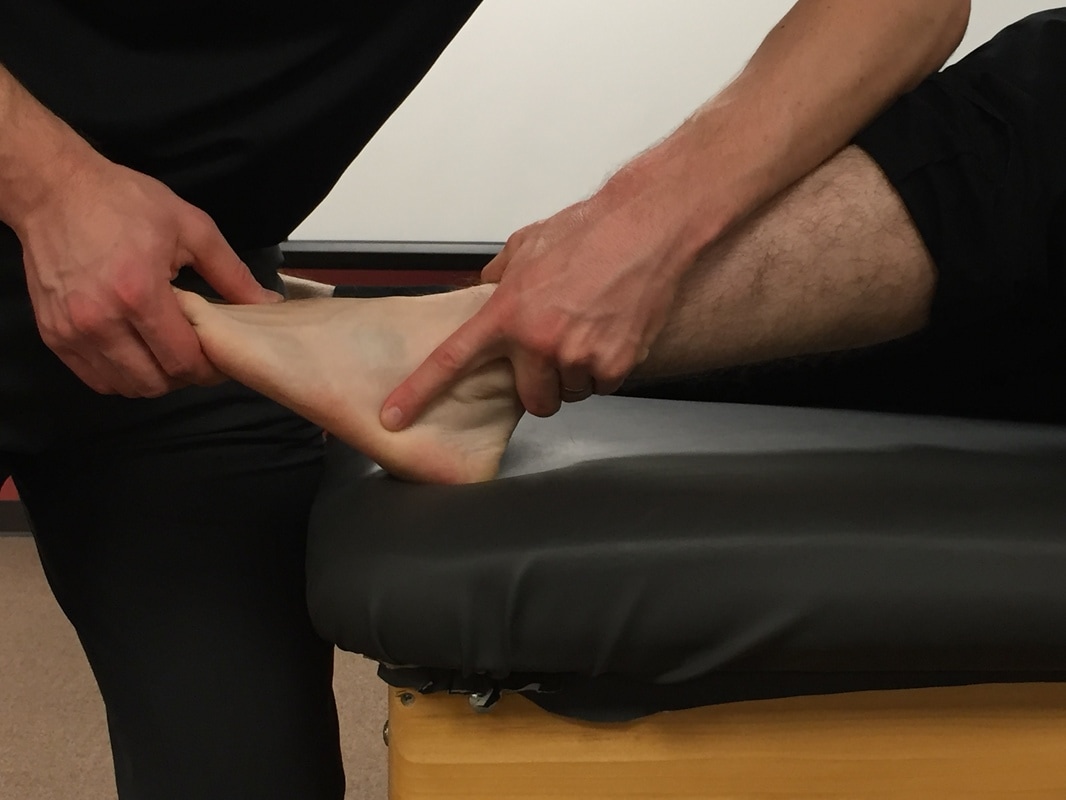


Anterior Drawer Test
Purpose: To test for ligamentous laxity or instability in the ankle. This test primarily assesses the strength of the Anterior Talofibular Ligament.
Test Position: Supine or Sitting.
Performing the Test: The examiner stabilizes the anterior distal leg with one hand & grasps the patient's calcaneus and rear foot with their second hand. The examiner then places the patient's foot into 10-15 degrees of plantar flexion and translates the rear foot anteriorly. A positive test results if the talus translates forward. Positive test results are often graded on a "0 to 3 scale", with 0 indicating no laxity & 3 indicating gross laxity.
Diagnostic Accuracy: Sensitivity: .71; Specificity: .33; +LR: 1.06, -LR: .88
Importance of Test: The anterior drawer test is a beneficial test to perform in a patient following an inversion ankle sprain (injury to the lateral collateral ligaments). The 3 main components of the Lateral Collateral Ligaments of the ankle include the anterior talofibular ligament (ATFL), calcaneofibular ligament, and posterior talofibular ligament. The ATFL courses from the anterior aspect of the lateral malleolus to the anterior medial aspect of the neck of the talus. The function of the ATFL is to resist anterior translation of the ankle and prevent internal rotation of the talus on the tibia. Based off the anatomical orientation, placing the ankle into 10-15 degrees of plantar flexion puts a stress on the ligament, which is enhanced when a posterior to anterior translation is applied. Because there is a subjective grading scale (0-3) for laxity, it is important for the novice clinician to critically assess the motion and patient's response during the test.
Note: these tests should only be performed by a properly trained health care practitioner.
Test Position: Supine or Sitting.
Performing the Test: The examiner stabilizes the anterior distal leg with one hand & grasps the patient's calcaneus and rear foot with their second hand. The examiner then places the patient's foot into 10-15 degrees of plantar flexion and translates the rear foot anteriorly. A positive test results if the talus translates forward. Positive test results are often graded on a "0 to 3 scale", with 0 indicating no laxity & 3 indicating gross laxity.
Diagnostic Accuracy: Sensitivity: .71; Specificity: .33; +LR: 1.06, -LR: .88
Importance of Test: The anterior drawer test is a beneficial test to perform in a patient following an inversion ankle sprain (injury to the lateral collateral ligaments). The 3 main components of the Lateral Collateral Ligaments of the ankle include the anterior talofibular ligament (ATFL), calcaneofibular ligament, and posterior talofibular ligament. The ATFL courses from the anterior aspect of the lateral malleolus to the anterior medial aspect of the neck of the talus. The function of the ATFL is to resist anterior translation of the ankle and prevent internal rotation of the talus on the tibia. Based off the anatomical orientation, placing the ankle into 10-15 degrees of plantar flexion puts a stress on the ligament, which is enhanced when a posterior to anterior translation is applied. Because there is a subjective grading scale (0-3) for laxity, it is important for the novice clinician to critically assess the motion and patient's response during the test.
Note: these tests should only be performed by a properly trained health care practitioner.
Reference: Flynn , Timothy. Users' Guide to Musculoskeletal Examination. USA: Evidence in Motion, 2008. Print.
Docherty, Carrie. "Reliability of the Anterior Drawer and Anterior Tilt Tests using the Ligmaster Joint Arthometer." 2009.
Neumann, Donald. Kinesiology of the Musculoskeletal System. 2nd Edition.
Copyright © The Student Physical Therapist LLC 2023